library(tidyverse)10 DS Workflow and Import
1 Data Science Workflow
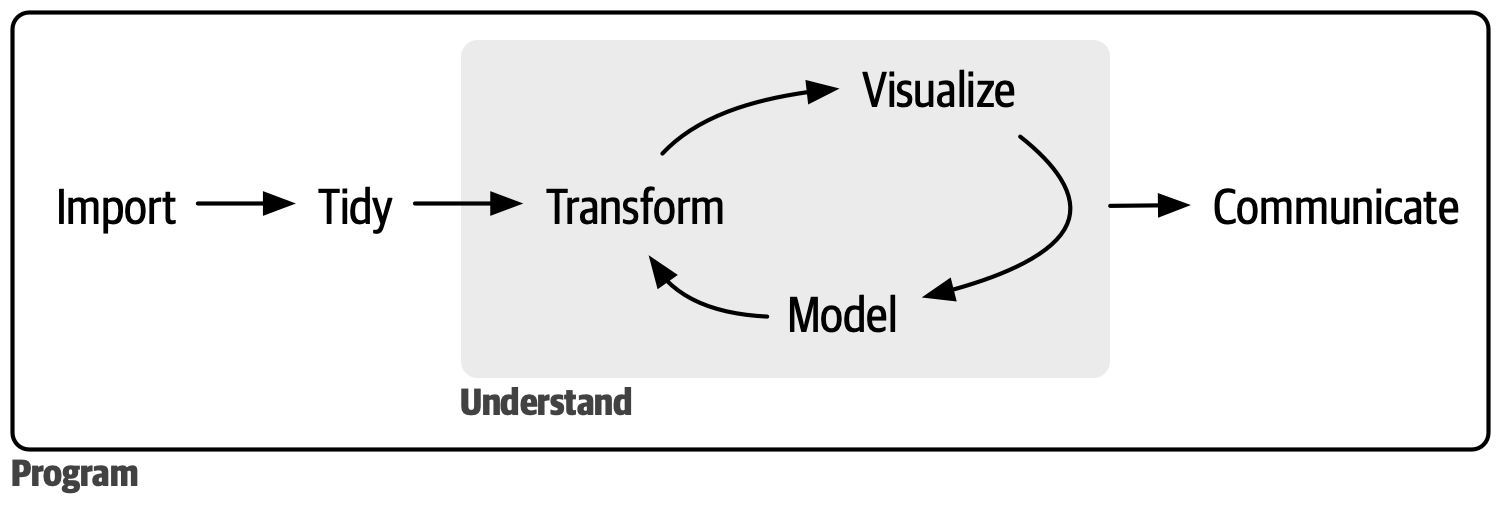
A typical data science project
Import
- Reading data from different sources, e.g., SAS, SPSS, Stata, Excel, SQL, etc.
Tidy
- When your data is tidy, each column is a variable and each row is an observation.
Transform
- Transformation includes:
- narrowing in on observations of interest,
- creating new variables that are functions of existing ones,
- calculating summary statistics (counts, means, etc.).
- narrowing in on observations of interest,
Together, tidying and transforming are called wrangling.
Visualize
- Visualization helps you see things you did not expect and raises new questions about your data.
Model
- Models summarize data and help answer precise questions.
Communicate
- Presenting results and writing reports.
2 The tidyverse
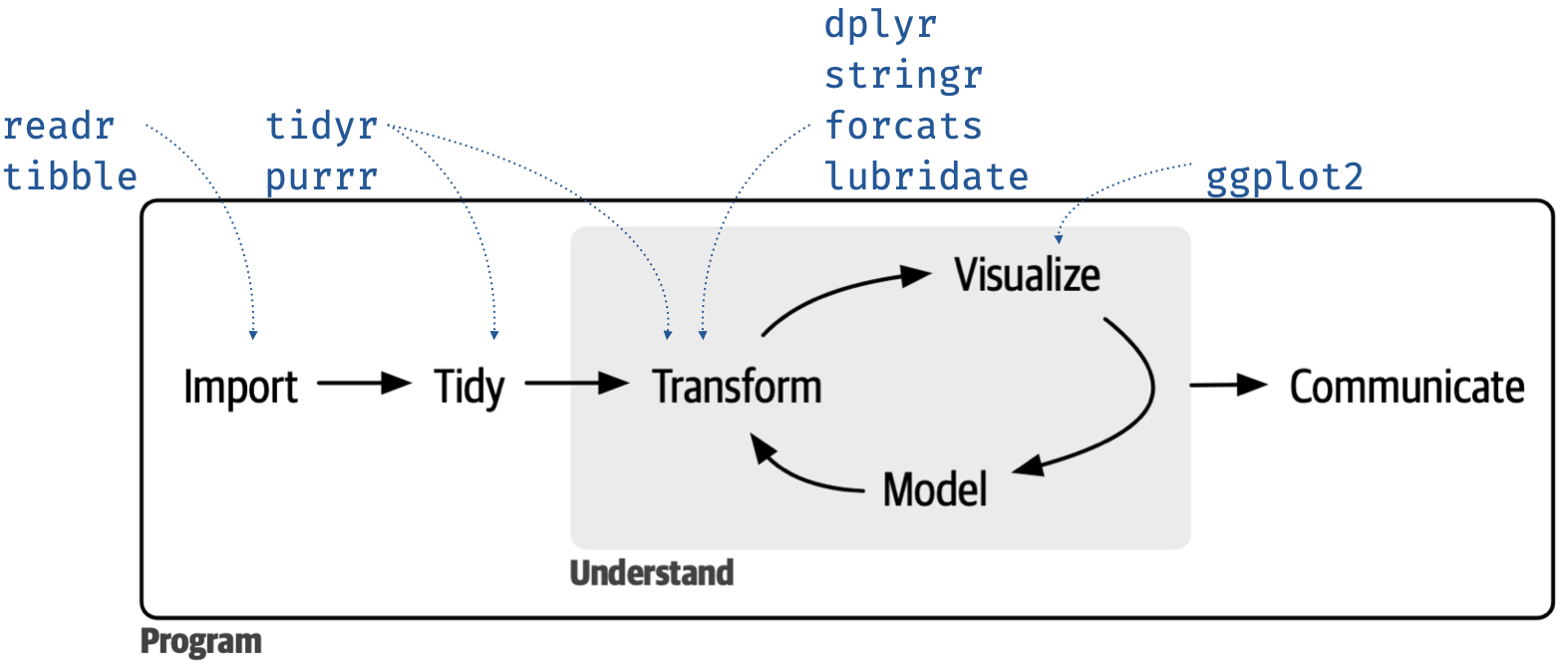
tidyverseis a collection of R packages:ggplot2,tibble,tidyr,readr,purrr,dplyr, and many more.
Shared philosophy and consistent design principles.
Code style is different from base R.
Hadley Wickham and colleagues develop
tidyversepackages at RStudio Inc.
See: Wickham & Grolemund (2017). R for Data Science.
- Loading
tidyverseautomatically loadsggplot2.
3 Importing Data
Importing data means loading data from external files into R for analysis. Real-world data usually comes from spreadsheets, statistical software, or databases.
Common Data Formats
- CSV (.csv)
- Excel (.xlsx, .xls)
- Text files (.txt)
- SPSS (.sav)
- Stata (.dta)
- SAS (.sas7bdat)
- R’s native data (.RData)
- Download this data folder for practice.
Importing CSV Files
Using read.csv():
Importing Excel Files
Install:
Read:
#> # A tibble: 6 × 8
#>   month time.at.station water.noise number.whales latitude longitude depth
#>   <chr>           <dbl> <chr>       <chr>            <dbl>     <dbl> <dbl>
#> 1 May              1344 low         7                 60.4     -4.18   520
#> 2 May              1633 medium      13                60.4     -4.19   559
#> 3 May               743 medium      12                60.5     -4.62  1006
#> 4 May              1050 medium      10                60.3     -4.35   540
#> 5 May              1764 medium      12                60.4     -5.2   1000
#> 6 May               580 high        10                60.4     -5.22  1000
#> # ℹ 1 more variable: gradient <dbl>
Importing Text Files
Using read.table():
Importing SPSS Files
Install:
Read:
#> # A tibble: 6 × 13
#>   year_birth   age division residence religion edu      wealth_index total_birth
#>        <dbl> <dbl> <chr>    <chr>     <chr>    <chr>    <chr>              <dbl>
#> 1       1988    26 Barisal  Rural     Islam    Primary  Poorest                2
#> 2       1973    41 Barisal  Rural     Islam    Primary  Middle                 4
#> 3       1976    38 Barisal  Rural     Islam    Primary  Poorest                2
#> 4       1996    18 Barisal  Rural     Islam    Seconda… Poorest                0
#> 5       1986    28 Barisal  Rural     Islam    Primary  Poorest                2
#> 6       1980    34 Barisal  Rural     Islam    Primary  Poorer                 3
#> # ℹ 5 more variables: current_pregnant <chr>, current_breast_feed <chr>,
#> #   edu_husband <chr>, bmi <dbl>, overweight <dbl>
Importing Stata Files
#> # A tibble: 6 × 13
#>   year_birth   age division residence religion edu      wealth_index total_birth
#>        <dbl> <dbl> <chr>    <chr>     <chr>    <chr>    <chr>              <dbl>
#> 1       1988    26 Barisal  Rural     Islam    Primary  Poorest                2
#> 2       1973    41 Barisal  Rural     Islam    Primary  Middle                 4
#> 3       1976    38 Barisal  Rural     Islam    Primary  Poorest                2
#> 4       1996    18 Barisal  Rural     Islam    Seconda… Poorest                0
#> 5       1986    28 Barisal  Rural     Islam    Primary  Poorest                2
#> 6       1980    34 Barisal  Rural     Islam    Primary  Poorer                 3
#> # ℹ 5 more variables: current_pregnant <chr>, current_breast_feed <chr>,
#> #   edu_husband <chr>, bmi <dbl>, overweight <dbl>
Importing SAS Files
#> # A tibble: 6 × 6
#>    YEAR     Y     W     R     L     K
#>   <dbl> <dbl> <dbl> <dbl> <dbl> <dbl>
#> 1  1948  1.21 0.243 0.145  1.41 0.612
#> 2  1949  1.35 0.260 0.218  1.38 0.559
#> 3  1950  1.57 0.278 0.316  1.39 0.573
#> 4  1951  1.95 0.297 0.394  1.55 0.564
#> 5  1952  2.27 0.310 0.356  1.80 0.574
#> 6  1953  2.73 0.322 0.359  1.93 0.711
Importing R’s native format
Data Entry in R
Sometimes you need to directly create a tibble:
Using Built-in Datasets
List datasets:
Load a dataset:
#>                    mpg cyl disp  hp drat    wt  qsec vs am gear carb
#> Mazda RX4         21.0   6  160 110 3.90 2.620 16.46  0  1    4    4
#> Mazda RX4 Wag     21.0   6  160 110 3.90 2.875 17.02  0  1    4    4
#> Datsun 710        22.8   4  108  93 3.85 2.320 18.61  1  1    4    1
#> Hornet 4 Drive    21.4   6  258 110 3.08 3.215 19.44  1  0    3    1
#> Hornet Sportabout 18.7   8  360 175 3.15 3.440 17.02  0  0    3    2
#> Valiant           18.1   6  225 105 2.76 3.460 20.22  1  0    3    1
Importing Datasets from Packages
Example: gapminder
#> # A tibble: 6 × 6
#>   country     continent  year lifeExp      pop gdpPercap
#>   <fct>       <fct>     <int>   <dbl>    <int>     <dbl>
#> 1 Afghanistan Asia       1952    28.8  8425333      779.
#> 2 Afghanistan Asia       1957    30.3  9240934      821.
#> 3 Afghanistan Asia       1962    32.0 10267083      853.
#> 4 Afghanistan Asia       1967    34.0 11537966      836.
#> 5 Afghanistan Asia       1972    36.1 13079460      740.
#> 6 Afghanistan Asia       1977    38.4 14880372      786.
Summary of Importing Functions
- CSV, Excel, Text:
readr::read_csv(),readxl::read_excel(),read.table() - SPSS, Stata, SAS:
haven::read_sav(),haven::read_dta(),haven::read_sas() - RData:
load() - R’s built-in data:
data() - Data from any R Package: Install the package, use
data()
Exporting Data
Exporting to R objects (.RData)
Exporting to CSV
Exporting to Text Files